
The Olde Farm, Virginia
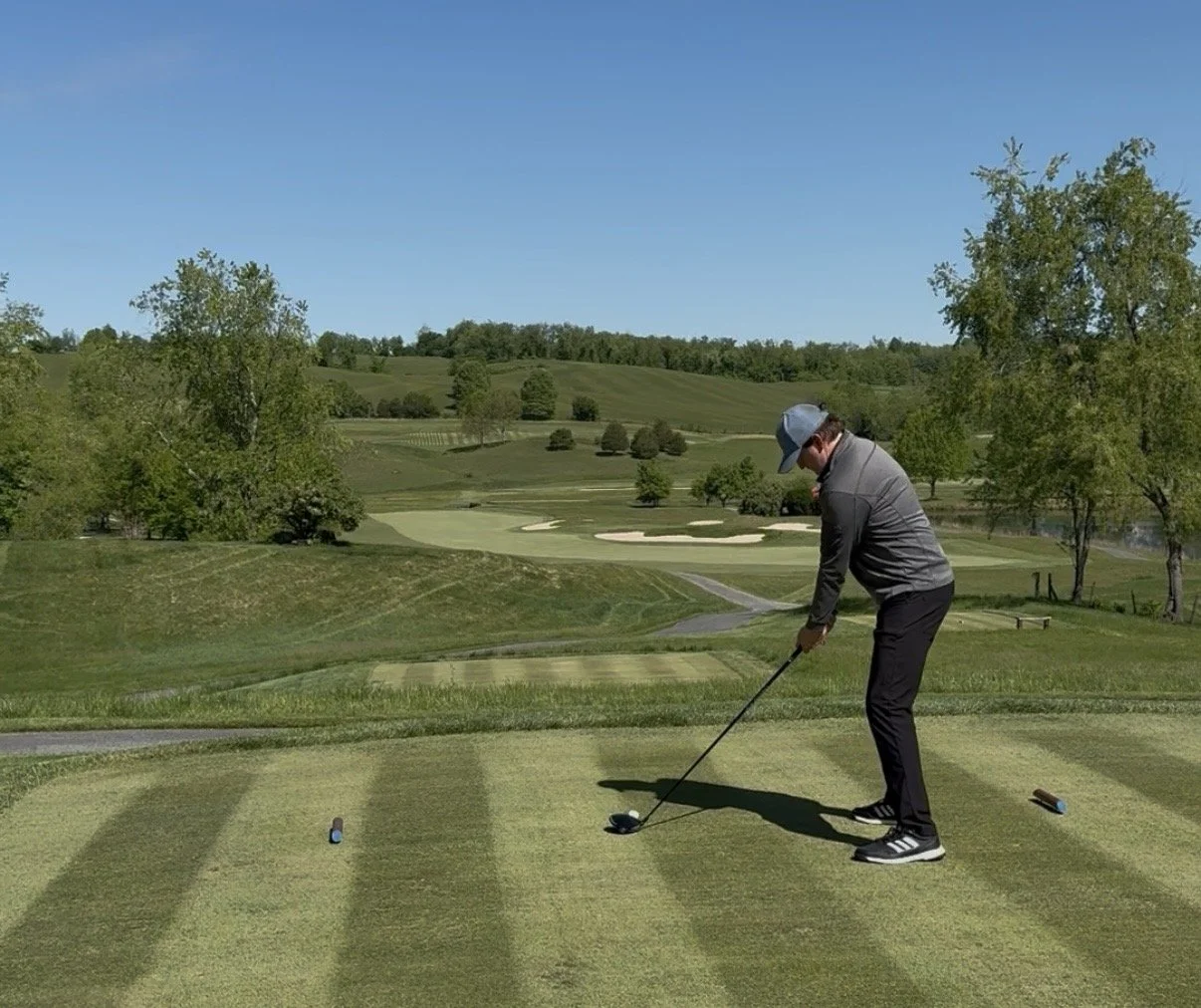
Teeing off on the par four thirteenth at The Olde Farm in Bristol, Virginia.
Recently I was given the opportunity to cut up US Interstate 81 through northeastern Tennessee and trek through southwestern Virginia to play golf. The decision was a no-brainer. The area around the Appalachian Mountains and the Great Smokies is visually stunning and full of noteworthy places, and the history and beauty of Virginia go far beyond that of Washington, DC and its surrounding area.
The Virginia golf scene is significantly more interesting than most realize. Kinloch has held the U.S. Mid Amateur, and Robert Trent Jones Golf Club, located in the DMV, has hosted both the Solheim and Presidents Cups. The Olde Farm is an Appalachian treasure, and Ballyhack is a premier Dormie Network club. On the public side of things, the Cascade course at The Homestead Resort, the Highland course at Primland Resort, and the Gold course at Golden Horseshoe Golf Club are all perennial top 100 members on national lists. The way each course fits into the Virginian terrain makes for scenic golf throughout the state.
I was lucky enough to play on a Friday morning this spring at The Olde Farm in Bristol. It is ranked first in Virginia by Top 100 Golf Courses, second by Golf Digest and 103rd overall in the country, and tied for ninety-seventh among modern American layouts by GolfWeek. And though the club only opened its doors in 2000, it has the look and feel of a place that has been around for a century. The Olde Farm Golf Club advertises itself on its website as “a place like no other”, and after visiting I completely understand the sentiment. It is a Bobby Weed design, and outlets everywhere hail it as his best. I teed it up with a kind assistant professional named Wallace who showed me the way and shared many details on The Olde Farm’s history. He was a great guy whose insight clearly elevated the experience of my round.
The course is defined by its wide, rounded fairways and the number of ways in which you can approach each shot. The views of the surrounding area are sprawling and dramatic. There are many water hazards in play, highlighted by Sinking Creek, and a fairway that bisects the first, tenth, and eleventh holes, creating a unique landing area on a few holes that normally would be swallowed up by rough. At some points it is over 200 yards wide.
A hole on the front nine that encompasses The Olde Farm experience is the second, a 502-yard par four monster played to a ginormous fairway with an approach over a creek to a green that can play a million different ways because of the contoured green and pin placement. The fifth showcases a punchbowl green, a tip of the cap to the classic courses that made the feature famous. I also thoroughly enjoyed the 322-yard par four eighth. It is drivable for the longest hitters, but the excellently shaped bunkers and fairway placement open up several different strategic routes.
While the first half is great, the back nine is even better. The thirteenth is a stunning 434-yard par four that will stick with you long after you’ve struck the tee shot. Standing on the box I could hear birds chirping, and it almost felt as though I was hitting a shot in a televised golf tournament. The ambience of this place is just so cool.
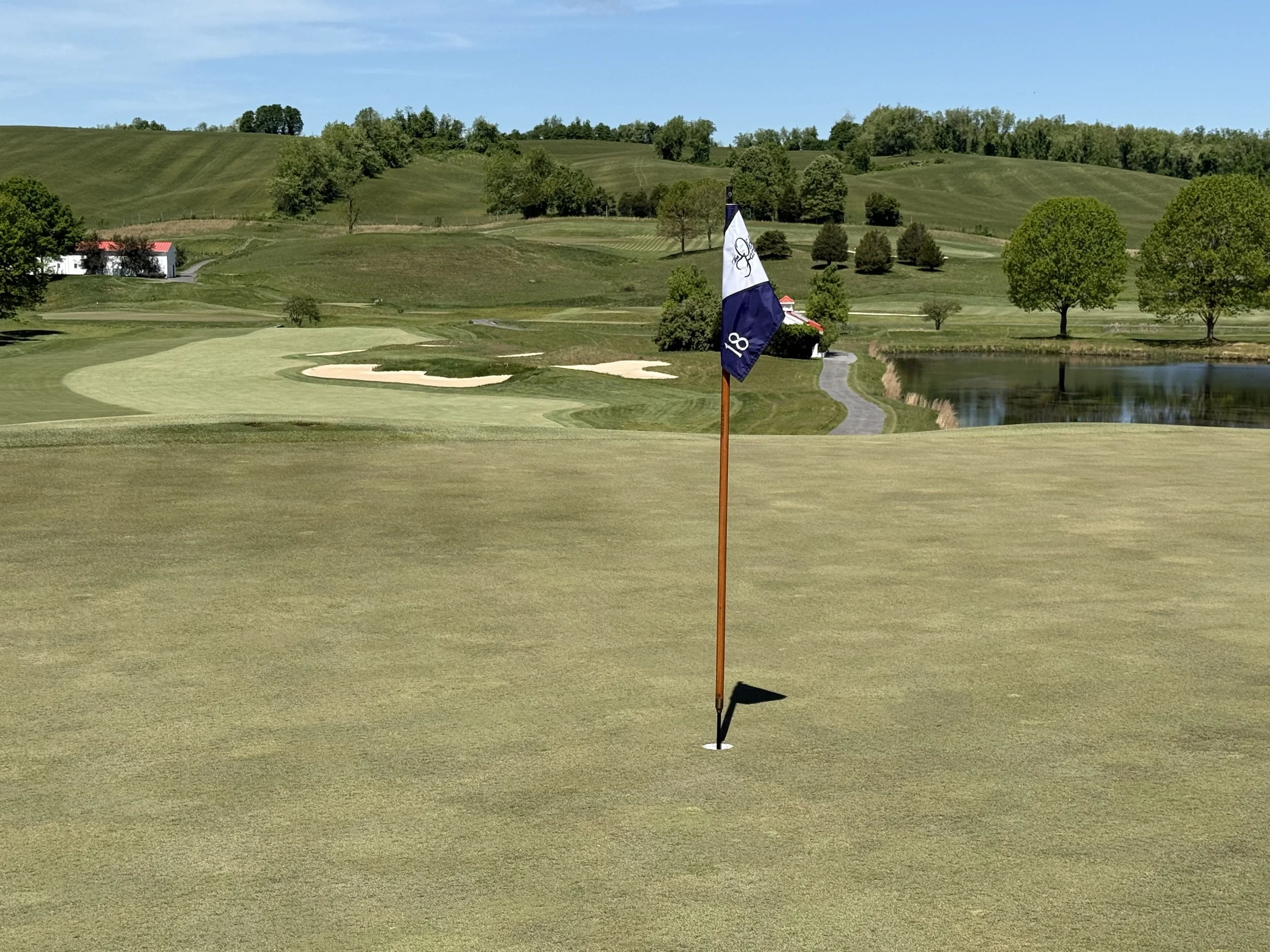
The fifteenth is a downhill, picturesque short iron into a kidney bean-shaped guarded by bunkers in the front and a pond behind fully equipped with railroad ties Pete Dye would be proud of. Make sure you take in this awesome moment during your awesome round.
Let’s nitpick for a second and discuss a “con” at The Olde Farm. Other than the fifteenth, and perhaps the sixth due to the aesthetic appeal of the halfway house on the right, the par threes aren’t that memorable. But again, we’re just nitpicking.
“Fun” is probably the best word to describe an experience at The Olde Farm. There is a great degree of difficulty on many holes, but most are scoreable. When I finished, my caddie asked how I thought I played. I noted the couple of birdies and double bogeys on the scorecard. He shrugged and said, “Welcome to The Olde Farm.” In short, the course is an absolute blast.
“Rustic” is another word that comes to mind, owing to the outbuildings and barns situated throughout the property. One serves exclusively as a halfway house stocked to the brim with snacks and drinks and is accessible at least three times during your round. Even cooler, the Long Barn, as it is called, is wide enough to ride a cart through.
While we’re on the subject, The Olde Farm is full of nice touches you won’t find many other places. There is a nineteenth hole, a short par three, waiting for you at the end of your round. According to my caddie, it’s there to help settle bets and finish the round on a high note. There is also a nationally ranked par three course on the property called The Orchard. It has no official yardage, no defined tee boxes, and, like its championship counterpart, no shortage of fun. The nine green complexes can be played in any order. When I finished my round on the big boy course, I was instructed to grab a wedge and a putter and pointed toward a Sunday bag the club provided. The greens are small, but I could envision many scenarios in which time at The Orchard would sharper your game on the other nineteen.
The Olde Farm is supremely conditioned, well routed, and just an all around fun golf course. It’s one of those special places that, for some reason, flies under the radar in conversations about elite modern golf architecture. Anyone would be proud to call it their club. Without question, The Olde Farm is one of the best in the Appalachian Mountain region, and if you’re lucky enough to receive an invitation you’d be foolish to turn it down.